For my final project, I decided to focus on LGBT children’s literature because of the controversy surrounding its inclusion in schools and the importance of addressing LGBT issues in elementary, middle, and high schools. I chose three books that depicted three totally different situations in the LGBT community: a child with two lesbian mothers, a child of divorced parents whose father is gay and living with another man, and a middle school boy who realizes he is gay. I had a hard time trying to figure out which books to include in this project because there is such a small selection of LGBT books to choose from. While there are many LGBT books written each year, very few of these books are actually chosen to be on the shelves at bookstores and libraries. I believe that LGBT literature should be included as a part of diverse children’s literature just as much as other multicultural groups like African Americans and Native Americans.
From researching issues in the LGBT community for this project, I have found that the main reason LGBT children’s literature is not included in many bookstores and libraries is because parents have concerns with their children having access to these types of books. Parents seem to think that being gay is an “issue” that needs to be addressed instead of recognizing that homosexuality as a part of one’s identity. David Levithan, author of several pieces of LGBT literature says, “Being gay is not an issue, it is an identity. It is not something that you can agree or disagree with. It is a fact, and must be defended and represented as a fact.” It is important to include a variety of books in libraries and bookstores so that students can address their individual differences and feel included and accepted in their community. This way, children can compare their own lives and experiences to those of the characters in books, helping to promote high self-esteem and a positive sense of self. Because children are searching for their own identity as they go through elementary and especially middle and high school, it is important that they have access to books of all kinds so they don’t feel as if they are the only one experiencing the things they are feeling. It is imperative that questioning children have access to LGBT literature and other media for reassurance and support. The three books that I have chosen for this project portray homosexuality as a beautiful, natural, and loving thing; all three books are excellent examples of quality LGBT literature that should be included in schools, bookstores, and libraries. These books can help to educate children who know little or nothing about LGBT issues as well as serve as a resource for students who are questioning their sexual identity or have family members who are part of the LGBT community. Besides being good resources and quality books in terms of LGBT issues, these three books are also exemplary pieces of children’s literature in the general sense and should be included in children’s/young adult sections in libraries, schools, and bookstores.
Sunday, May 3, 2009

Professional Resource
Emfinger, Kay (2007). Rethinking welcoming literacy environments for LGBT families. (educating children on sex differences). Childhood Education. 84.1 (Fall 2007): 24(5). Academic OneFile. Gale. Michigan State University Libraries. 18 April. 2009.
As teachers, it is necessary that we communicate to our students the importance of accepting differences across individuals and families. In her article, Emfinger mentions that “Teachers often are shocked and in disbelief when someone points out that they are not embracing all children and families.” This quotation just proves that many teachers today do not even realize that they have to address LGBT issues because they don’t even consider LGBT as much of a cultural group as Native Americans or Latino(a)s. Making sure that students are treated equally and treat others equally is important in order to create a safe learning environment for all students. One way that we can help to facilitate a warm and welcoming classroom environment is to include a multitude of different pieces of multicultural children’s literature in our classrooms. This literature should span across many different religions, sexual orientations, races, ethnicities, cultures, etc. It is important to include literature that deals with all of these topics so that all students feel included and all issues are addressed and out in the open. Also, since students relate and connect with the characters in the books they read, it is vital to have a plethora of different types of books for students to read, especially when they are searching for their own personal identity. “Young children need to see their own experiences reflected and validated in school” (Emfinger, 24). This is why including many different types of diverse literature is so essential in schools as well as libraries and bookstores. However, LGBT literature as well as the LGBT community is often left out from libraries and bookstore shelves because of the parent’s concerns that their children are learning about homosexual sex or just homosexuality itself. Since many parents think being gay is an “issue” rather than a fact and part of one’s identity, they most often do not want their children learning about the LGBT community. As teachers, we need to realize that being gay is not an “issue” but a way of life for many people and should be included in the definition of multicultural children’s literature. We need to realize that the LGBT community is a diverse group that deserves recognition and respect just as much as any other group considered “multicultural.” We also need to be aware of the large amount of LGBT children’s literature available that is just not being made accessible in libraries and bookstores. Many of the LGBT books available in libraries and bookstores for children today “most[ly] focus on parental sexuality and family structure rather than families engaged in day-to-day activities” (Emfinger, 24). It is important to remember that as teachers we need to make sure to include and be aware of each family’s differences; that is the only way to support and understand our students.
Another important benefit of including quality LGBT literature in our schools is the positive effect it can have on our students as leaders in the future. “The eradication of institutionalized homophobia, the building of exemplary bias-free learning communities, and the inclusion of resources that support the infusion of diversity practices into the classroom can have a dramatic, positive impact upon K-12 environments-the home of tomorrow's leaders.” (Emfinger, 25). If we as teachers can recognize our own biases and stereotypes, we can better educate our students and communicate a message of acceptance across all groups of diverse people. If we model a sense of openness and approval of the LGBT community, we can help to provide our students with a new way to look at the world and especially at people who are different from them.
As teachers, it is necessary that we communicate to our students the importance of accepting differences across individuals and families. In her article, Emfinger mentions that “Teachers often are shocked and in disbelief when someone points out that they are not embracing all children and families.” This quotation just proves that many teachers today do not even realize that they have to address LGBT issues because they don’t even consider LGBT as much of a cultural group as Native Americans or Latino(a)s. Making sure that students are treated equally and treat others equally is important in order to create a safe learning environment for all students. One way that we can help to facilitate a warm and welcoming classroom environment is to include a multitude of different pieces of multicultural children’s literature in our classrooms. This literature should span across many different religions, sexual orientations, races, ethnicities, cultures, etc. It is important to include literature that deals with all of these topics so that all students feel included and all issues are addressed and out in the open. Also, since students relate and connect with the characters in the books they read, it is vital to have a plethora of different types of books for students to read, especially when they are searching for their own personal identity. “Young children need to see their own experiences reflected and validated in school” (Emfinger, 24). This is why including many different types of diverse literature is so essential in schools as well as libraries and bookstores. However, LGBT literature as well as the LGBT community is often left out from libraries and bookstore shelves because of the parent’s concerns that their children are learning about homosexual sex or just homosexuality itself. Since many parents think being gay is an “issue” rather than a fact and part of one’s identity, they most often do not want their children learning about the LGBT community. As teachers, we need to realize that being gay is not an “issue” but a way of life for many people and should be included in the definition of multicultural children’s literature. We need to realize that the LGBT community is a diverse group that deserves recognition and respect just as much as any other group considered “multicultural.” We also need to be aware of the large amount of LGBT children’s literature available that is just not being made accessible in libraries and bookstores. Many of the LGBT books available in libraries and bookstores for children today “most[ly] focus on parental sexuality and family structure rather than families engaged in day-to-day activities” (Emfinger, 24). It is important to remember that as teachers we need to make sure to include and be aware of each family’s differences; that is the only way to support and understand our students.
Another important benefit of including quality LGBT literature in our schools is the positive effect it can have on our students as leaders in the future. “The eradication of institutionalized homophobia, the building of exemplary bias-free learning communities, and the inclusion of resources that support the infusion of diversity practices into the classroom can have a dramatic, positive impact upon K-12 environments-the home of tomorrow's leaders.” (Emfinger, 25). If we as teachers can recognize our own biases and stereotypes, we can better educate our students and communicate a message of acceptance across all groups of diverse people. If we model a sense of openness and approval of the LGBT community, we can help to provide our students with a new way to look at the world and especially at people who are different from them.
Molly's Family

Garden, N. (2004). Molly's family. New York: Farrar, Straus, & Giroux.
Molly’s Family is the story of Molly, a kindergartner with two mommies (a birth mom and an adopted mom). For Open School Night, Molly and her classmates draw pictures of their families to put on the wall; one of the students (Tommy) notices that Molly’s family is different and begins to criticize her for having two mommies. Tommy says that a family cannot have two mommies and Molly is confused because that is the only family she has ever known. The book shows Molly’s mommies and teacher trying to explain to her that all families are different, and Molly finally realizes it when she sees all the different types of family structures at Open School Night.
This book communicates a strong message that all families are different, and that it’s okay to be different. The book also shows the importance of realizing that it doesn’t matter what your family looks like as long as there is happiness and love. The illustrations in the book are colorful and vibrant and the text can be easily understood by younger children. I think this book also allows all students—and not just those with parents in the LGBT community—that all families have different make-ups. Some children have a mom and a dad, some children have just a mom or just a dad, and some children live with their grandparents or an Aunt or Uncle. This book helps to wash away the stereotype of the “perfect American Family” that consists of a mother, father, two children, and a dog. There has been a lot of controversy over this book because many parents think that elementary school is too young to introduce their students to the LGBT community. Many parents confuse educating students about homosexuality with providing details about homosexual sex—but this is not the case. Homosexuality does not have to be about sex, but about educating students about homosexuality so they are less judgmental and more accepting and aware of all types of people. I think that by communicating an overall message of love and different family make-ups, this book helps to educate students about people in the LGBT community. I think that students with LGBT parents would really be able to relate to Molly’s character because they too might have felt confused or ridiculed because their parents and family structure were different. I think that this book is an excellent example of quality LGBT literature for young children, and should be included in the collection of multicultural children’s literature at libraries and bookstores.
This book communicates a strong message that all families are different, and that it’s okay to be different. The book also shows the importance of realizing that it doesn’t matter what your family looks like as long as there is happiness and love. The illustrations in the book are colorful and vibrant and the text can be easily understood by younger children. I think this book also allows all students—and not just those with parents in the LGBT community—that all families have different make-ups. Some children have a mom and a dad, some children have just a mom or just a dad, and some children live with their grandparents or an Aunt or Uncle. This book helps to wash away the stereotype of the “perfect American Family” that consists of a mother, father, two children, and a dog. There has been a lot of controversy over this book because many parents think that elementary school is too young to introduce their students to the LGBT community. Many parents confuse educating students about homosexuality with providing details about homosexual sex—but this is not the case. Homosexuality does not have to be about sex, but about educating students about homosexuality so they are less judgmental and more accepting and aware of all types of people. I think that by communicating an overall message of love and different family make-ups, this book helps to educate students about people in the LGBT community. I think that students with LGBT parents would really be able to relate to Molly’s character because they too might have felt confused or ridiculed because their parents and family structure were different. I think that this book is an excellent example of quality LGBT literature for young children, and should be included in the collection of multicultural children’s literature at libraries and bookstores.
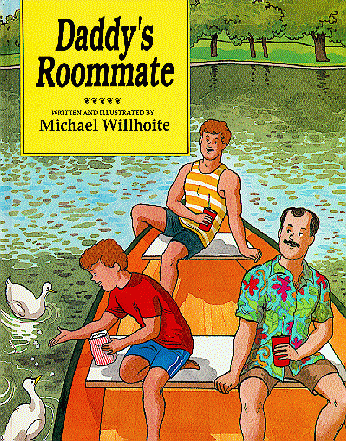
Daddy's Roommate

Willhoite, M. (1990). Daddy's roommate. Los Angeles: Alyson Publications.
Daddy’s Roommate tells the story of a little boy whose parents are divorced and whose father begins dating and living with another man named Frank. The book shows the boy as being accepting and loving to Frank as they do normal, everyday activities together. The book also shows the boy’s Daddy and Frank performing their daily activities such as sleeping, cooking, and shopping together, as any “normal” straight couple would. It isn’t until the end of the book that the little boy tells the reader that his Daddy and Frank are gay and that “being gay is just one more kind of love” (Willhoite, 26).
I thought that the illustrations and text in the book was straight-forward and could be easily understood and read by young children. The book conveys an overall message that being gay is not really that much different than being straight, besides the fact that the relationship is not about a man and a woman. Because the book depicts Daddy and Frank as they go about their everyday lives, it shows the reader that it is natural and “normal” to be gay just as it is to be straight. I liked that the book showed the little boy accepting his father and Frank as a couple and the issue of being gay didn’t seem to be a big deal in the book. In my professional resource, Emfinger mentions that “Rarely do books portray LGBT characters as normal people living everyday lives” (Emfinger, 24). I think this book does an excellent job of showing LGBT characters as regular people, much the same as straight people. I think that one of the reasons why there is so much controversy surrounding this book is because there are a couple illustrations and text that show the two men in bed together and in their underwear shaving together. While some parents may find this disturbing and too mature to show to their young children, I disagree. We have to show students that gay couples are a reality, and the longer we keep pretending that homosexuality is just a phase or an “issue” we have to deal with, the more homophobia and prejudice will remain prevalent in our society. Similar to Molly’s Family, this book also emphasizes the fact that all family make-ups are different, whether gay or straight. We need to teach students that it is okay to be different because that is what makes us unique. I would definitely recommend Daddy’s Roommate as an exemplary piece of LGBT children’s literature because it sends positive messages and is one of the few books that shows LGBT characters performing normal, everyday activities.
I thought that the illustrations and text in the book was straight-forward and could be easily understood and read by young children. The book conveys an overall message that being gay is not really that much different than being straight, besides the fact that the relationship is not about a man and a woman. Because the book depicts Daddy and Frank as they go about their everyday lives, it shows the reader that it is natural and “normal” to be gay just as it is to be straight. I liked that the book showed the little boy accepting his father and Frank as a couple and the issue of being gay didn’t seem to be a big deal in the book. In my professional resource, Emfinger mentions that “Rarely do books portray LGBT characters as normal people living everyday lives” (Emfinger, 24). I think this book does an excellent job of showing LGBT characters as regular people, much the same as straight people. I think that one of the reasons why there is so much controversy surrounding this book is because there are a couple illustrations and text that show the two men in bed together and in their underwear shaving together. While some parents may find this disturbing and too mature to show to their young children, I disagree. We have to show students that gay couples are a reality, and the longer we keep pretending that homosexuality is just a phase or an “issue” we have to deal with, the more homophobia and prejudice will remain prevalent in our society. Similar to Molly’s Family, this book also emphasizes the fact that all family make-ups are different, whether gay or straight. We need to teach students that it is okay to be different because that is what makes us unique. I would definitely recommend Daddy’s Roommate as an exemplary piece of LGBT children’s literature because it sends positive messages and is one of the few books that shows LGBT characters performing normal, everyday activities.
So Hard to Say

Sanchez, Alex (2005). So Hard To Say. New York: Simon & Schuster Books for Young Readers.
http://www.alexsanchez.com/So_Hard_To_Say/So_Hard_To_Say_Home_Page.htm
So Hard to Say is a novel intended for middle school students and captures the lives of two teens specifically: Xio and Frederick. Xio is a typical middle school girl who is interested in boys but is still trying to find her identity and figure out who she is as a person. She likes Frederick romantically, but he does not seem to share her affection in the same way. Frederick is the new kid at school who seems to be confused about his sexual identity for the majority of the book. Frederick likes Xio, but just as a friend; he does not understand why he does not have romantic feelings for her but is instead attracted to his friend and soccer player Victor. The book provides a glimpse into the minds of both Xio and Frederick as both kids are struggling to figure out their place in society. The book also shows the inward battle Frederick goes through as he tries to figure out his sexual orientation in a place where being gay is social suicide.
Alex Sanchez is the author of many other young adult novels dealing with LGBT issues such as Rainbow Boys, Rainbow Road, and Rainbow High (those novels are geared towards high school students). In an interview with Alex Sanchez about what draws him to write stories with gay themes, he said “Books often hold a special place when you’re gay or different, giving you hope for a world in which it’s okay to be who you are.” I found that Sanchez explores a lot of important issues dealing with the LGBT community in So Hard to Say. While reading the book, I found myself relating to both the characters of Xio and Frederick, although I’m not gay myself. Although I’ve never had to go through anything close to what Frederick went through, I could really feel his emotions coming off the page and imagine what it would be like to be in his shoes. I thought that Frederick was a very well-developed character because he was truly struggling to figure out his sexual orientation while having to deal with the romantic pressure from Xio as well as deal with the consequences of admitting to himself and others that he was gay. I also found the character of Xio believable and authentic as well because while she was hurt and confused when she found out Frederick might be gay, she also accepted him and remained friends with him; this is a positive message to send to students who may also be questioning their sexual identity. Additionally, I thought that the character of Iggy (a homosexual classmate of Xio and Frederick) was important to the story and to students who read this book. Although other kids at school made fun of Iggy, he remained optimistic and happy and accepted who he was no matter what people thought. I think that that sends an important message to students who read this book, no matter if they are LGBTQ or straight.
One thing that I noticed about the book that I did not particularly like was some of the aspects of Frederick’s personality. For example, he is described in the book as “artsy,” “creative,” and someone who loves to design things and wants to be an interior designer when he gets older. One of the articles we read in class talked about this aspect of gay and lesbian stereotypes in novels: “A recurring stereotype that, as an insider, I found annoying was that of the artistically sensitive homosexual” (McLean, 185). However, besides this instance I consider So Hard to Say an outstanding piece of LGBT literature that children should have access to in libraries and bookstores.
Alex Sanchez is the author of many other young adult novels dealing with LGBT issues such as Rainbow Boys, Rainbow Road, and Rainbow High (those novels are geared towards high school students). In an interview with Alex Sanchez about what draws him to write stories with gay themes, he said “Books often hold a special place when you’re gay or different, giving you hope for a world in which it’s okay to be who you are.” I found that Sanchez explores a lot of important issues dealing with the LGBT community in So Hard to Say. While reading the book, I found myself relating to both the characters of Xio and Frederick, although I’m not gay myself. Although I’ve never had to go through anything close to what Frederick went through, I could really feel his emotions coming off the page and imagine what it would be like to be in his shoes. I thought that Frederick was a very well-developed character because he was truly struggling to figure out his sexual orientation while having to deal with the romantic pressure from Xio as well as deal with the consequences of admitting to himself and others that he was gay. I also found the character of Xio believable and authentic as well because while she was hurt and confused when she found out Frederick might be gay, she also accepted him and remained friends with him; this is a positive message to send to students who may also be questioning their sexual identity. Additionally, I thought that the character of Iggy (a homosexual classmate of Xio and Frederick) was important to the story and to students who read this book. Although other kids at school made fun of Iggy, he remained optimistic and happy and accepted who he was no matter what people thought. I think that that sends an important message to students who read this book, no matter if they are LGBTQ or straight.
One thing that I noticed about the book that I did not particularly like was some of the aspects of Frederick’s personality. For example, he is described in the book as “artsy,” “creative,” and someone who loves to design things and wants to be an interior designer when he gets older. One of the articles we read in class talked about this aspect of gay and lesbian stereotypes in novels: “A recurring stereotype that, as an insider, I found annoying was that of the artistically sensitive homosexual” (McLean, 185). However, besides this instance I consider So Hard to Say an outstanding piece of LGBT literature that children should have access to in libraries and bookstores.
Monday, March 2, 2009
Final Project Idea
For my final project idea, I want to focus on gay/lesbian issues in children and/or adolescent literature. I have been to several LGBT meetings and the topics and issues really interest me. Also, since we are reading the book Boy Meets Boy later on in the semester, I think it would be interesting to find other examples of gay/lesbian literature. Hopefully after the library visit today, I will be more comfortable with doing research on the project.
Sunday, February 22, 2009
Habibi Discussion
In my group's discussion last week, we talked a lot about the differences between the book Habibi and the documentary we watched in class a couple weeks ago. Because the experiences of the characters in the book (Liyana and Omer) were vastly different from the kids in the documentary, we first wondered if the author of Habibi was an insider and a credible source. After realizing that she is both of these things, it was hard for me to grasp the discrepancies between Liyana and Omer's friendship and the friendships of the children in the documentary. It seemed a lot easier for Liyana and Omer to become friends; they didn't grow up hating one another because of their race, religion, ethnicity, as the children in the documentary did. I wonder: Are these just very different experiences? Or were circumstances in Israel vastly different in the setting of Habibi than they were in the time of the documentary?
Wednesday, January 28, 2009
Norms for the Classroom
I'm really glad that we took time in class on Monday to talk about the norms that we wanted for our classroom. I think it is really important to put things out in the open from the beginning so that everyone can feel comfortable and secure sharing personal thoughts/feelings/ideas, etc. It can be difficult in a class focused on power and diversity to all agree on issues and have the same opinions. I appreciated that we were able to come up with some rules/norms for our class individually and then collectively create a list. I have been in classes before where people are rude, ignorant, or indifferent to other's feelings, backgrounds, etc. and it doesn't create a very happy and comforting classroom environment. It is important to listen to each other, have powerful and meaningful discussions and debates, and take other people's different backgrounds/feelings/opinions/personal experiences into accounts when making judgements. I extend that courtesy to others and I expect that in return!
Monday, January 26, 2009
Autobiographical Poem
I am Leigh Ann
Daughter of Diane
Who needs sleep, peace, and acceptance
Who loves her family, friends, and music
Who sees lost loved ones in her dreams
Who hates liars, Mondays, and celery
Who fears death and the real world
Who dreams of the future and the past
Who has found poems of love to be hopeful and exciting
Resident of East Lansing, Dearborn, and Michigan
Myrold-Arseneau
Daughter of Diane
Who needs sleep, peace, and acceptance
Who loves her family, friends, and music
Who sees lost loved ones in her dreams
Who hates liars, Mondays, and celery
Who fears death and the real world
Who dreams of the future and the past
Who has found poems of love to be hopeful and exciting
Resident of East Lansing, Dearborn, and Michigan
Myrold-Arseneau
Subscribe to:
Comments (Atom)